Why Is There Strong Fascination With Nonwestern Art Culture in the United States
Why portraits have fascinated united states for millennia
(Image credit:
Von der Heydt-Museum Wuppertal
)
From ancient times to today, portraiture has told united states of america fundamental truths about humanity and identity, whoever the subject. Cath Pound explores the genre'due south well-nigh powerful examples.
P
Portraiture has a unique identify in the history of art. By looking at who was portrayed, and how, nosotros are able to gain insights into social, cultural and political history that no other type of painting can offer. The fact that it offers an opportunity to connect with individuals who were, or are, living breathing homo beings just like u.s., also makes information technology one of the most accessible and pop; it is the only genre with its ain dedicated galleries, and has offered inspiration for countless major exhibitions.
More similar this:
- The clandestine lives of the first ladies
- The individual life of a masterpiece
- The artist skewering white privilege
"Portraiture stands apart from other genres of fine art as it marks the intersection between portrait, biography and history. They are more than artworks; when people look at portraits, they think they are encountering that person," says Alison Smith, master curator at the National Portrait Gallery in London.
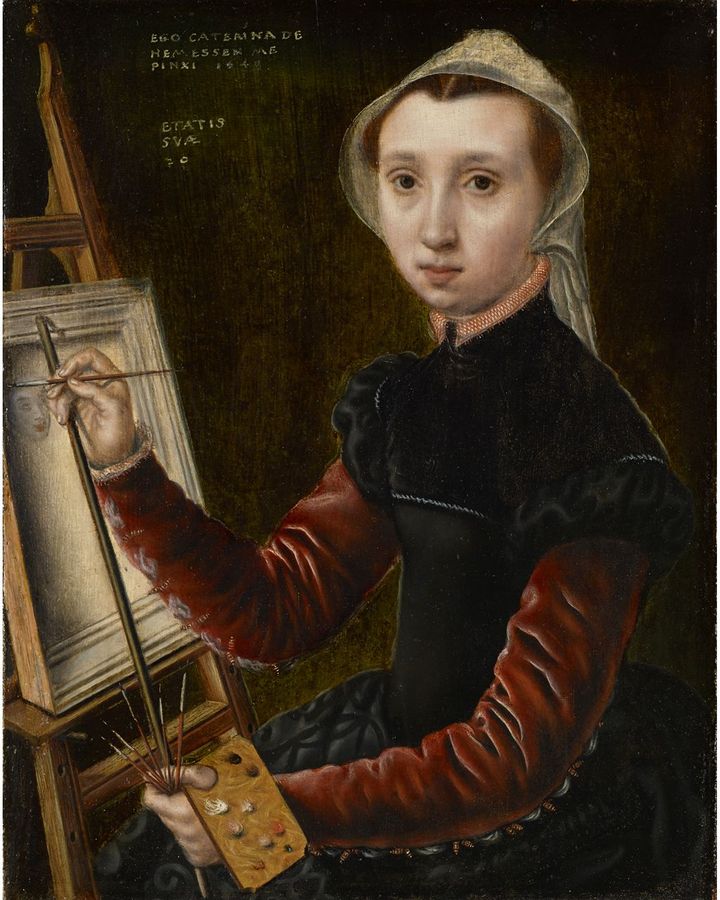
The striking cocky-portrait by Catharina van Hemessen focuses on her identity as an artist (Credit: Kunstmuseum Basel)
The genre'due south origins tin can be traced dorsum to aboriginal times, when information technology served a number of functions, from exalting those in power to remembering the dead. The 1st and 2nd Centuries AD saw the Fayum area of Roman Egypt produce astonishingly naturalistic portraits that appeared on mummy cases. It is thought they may have hung in people's homes during their lifetimes, and after death were placed over the caput of their mummy in society to help their journeying to the afterlife. In Ancient Rome portrait sculpture was used to commemorate the dead or celebrate the achievements of the living. In both cases, attention was fatigued to the person's lineage, which was of great importance in Roman club. Majestic portraits were a valuable tool for propaganda. Placed in temples of the imperial cult, they were designed to inspire awe and subordination.
Although few examples of portraiture survive from the Eye Ages, those that do served similar purposes as those from classical times. The stunning life-sized mosaics of the Emperor Justinian and Empress Theodora in the church of San Vitale in Ravenna – which date from the 6th Century – are a particularly spectacular demonstration of power.
Stand up-alone portraits of those in the center ranks of society did not appear until the 15th Century with Jan van Eyck's The Spousal relationship of the Arnolfini from 1434 existence ane of the about renowned. One of the first standing double portraits in the history of fine art, the couple'south lifelike countenances combined with the mysterious symbolism subconscious inside the painting make it enduringly pop with visitors to London'southward National Gallery.
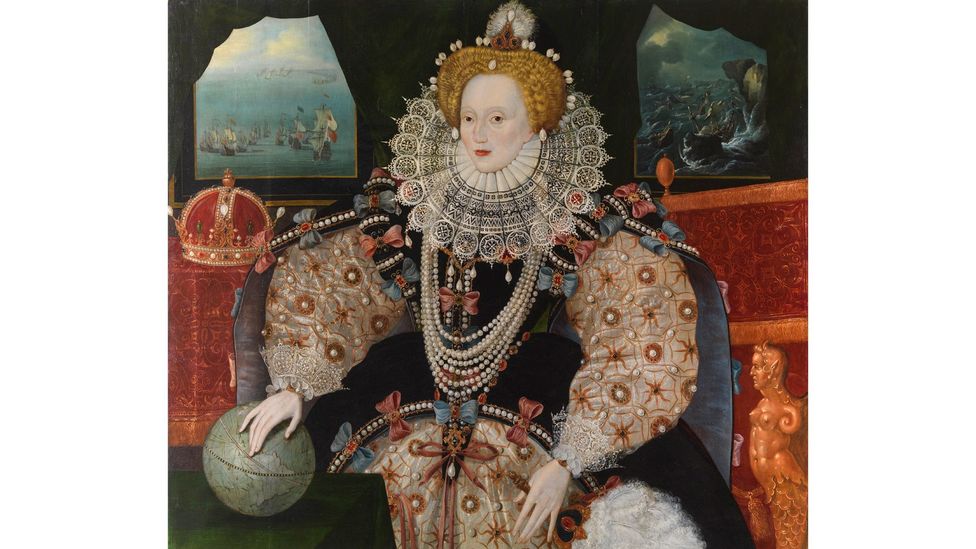
A portrait of Queen Elizabeth l to celebrate the Fleet emphasises her status every bit the "Virgin Queen" in the pearl-bodice particular (Credit: National Maritime Museum)
It was during the Renaissance that portraiture truly came into its ain. This has oft been idea to be the event of a growing sense of individuality stimulated by an increasing interest in humanism, but Matthias Ubl, curator of the Rijksmuseum's recent Remember Me exhibition, cautions against this overly simplistic viewpoint. "In that location were many factors helping portraiture to flourish at that fourth dimension," Ubl tells BBC Civilization. "It was a menses of innovation and stirring things up. Humanism became very of import, so the cocky did too in a way, but that was not everything. The growth of cities saw the rise of a mercantile elite which wanted to mirror the nobility by having their portrait painted."
And while these newly-wealthy businessmen were keen to show off their success, in that location were certain expectations that had to exist abided by for the sake of propriety. "You lot still have the Church, you also have guild regulations, and they have to adhere to what society expected of them, whether that was beingness a virtuous woman or a good merchant," says Ubl.
These skillful merchants can exist seen in Hans Holbein's Portrait of Georg Gisze and Jan Gossart's Portrait of Jan Jacobsz Snoeck. Like most merchants of the era, they are likely to have traded in a various range of goods. Even so, any allusion to this merchandise is conspicuous by its absenteeism, maybe because it was besides closely associated with manual labour. Instead they chose to show themselves lavishly dressed and surrounded by letters, documents and writing materials. It was condition and wealth that they wished to emphasise.
Although the status and wealth of women were every bit obvious in the fine clothing and jewellery they wore in their portraits, it was their beauty and virtue that patriarchal expectations forced them to emphasise, the erstwhile often being thought of as a physical manifestation of the latter. Fifty-fifty someone as powerful as Queen Elizabeth I knew her authority rested in no pocket-sized function on her image as the "Virgin Queen", married to England. In the Armada Portrait by an unknown creative person (currently on display at Queen'due south Firm, London) which was painted to celebrate the defeat of the invading Castilian navy, her hand rests confidently on a globe. Her bodice is encrusted with pearls, an appropriately ocean-grown keepsake of virginity. Notable exceptions to that dominion were self-portraits by female artists such every bit Catharina van Hemessen's Cocky Portrait at the Easel from 1548, in which she portrays herself working at her craft. "Her portrait is the earliest nosotros know showing an creative person painting at an easel. It's interesting that it was a female artist when they were and so rare," notes Ubl.
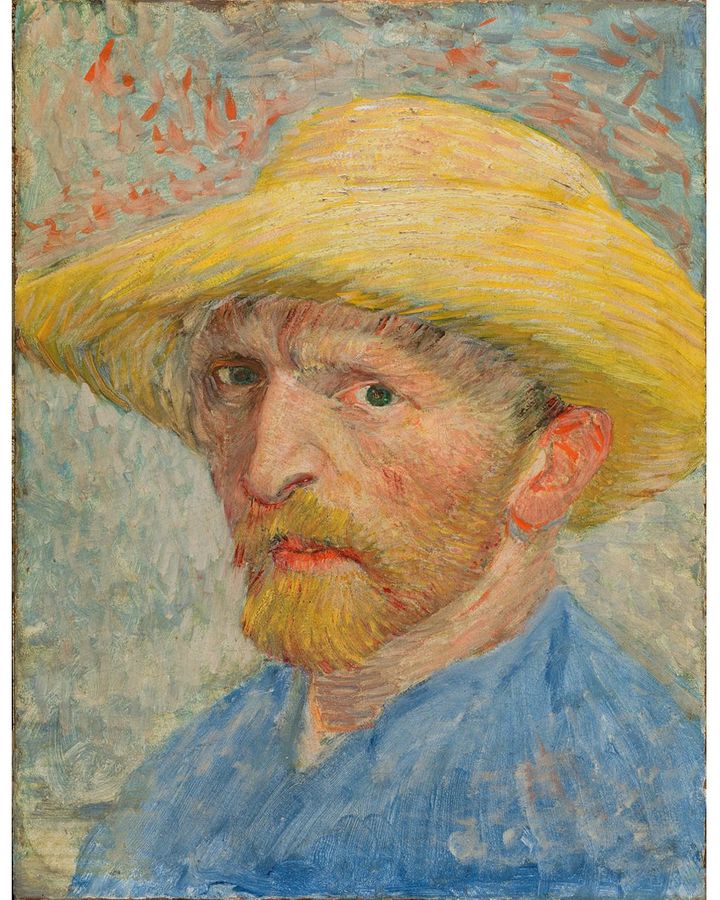
Van Gogh'southward powerful Cocky-Portrait with Straw Hat is on brandish at an exhibition at the Courtauld, London (Credit: The Detroit Institute of Arts, Bridgeman Images)
Portraiture'southward growing importance was solidified in the 17th Century when the French Royal Academy created a hierarchy of genres and placed it 2d only to history painting. The assumption was that it would document the dandy and the good, and thus serve as an accompaniment to the highest of all genres. This newly designated role for portraiture was behind the germination of the earliest portrait galleries, such every bit Charles Willson Peale's Gallery of Illustrious Personages which opened in Philadelphia in the 1770s, and featured many figures who had signed the Announcement of Independence. The UK's National Portrait Gallery followed in 1856 with the very first work to enter the drove existence a portrait of William Shakespeare.
Although these galleries only collected portraits of those they considered to be notable, with all the class, sex and race biases that this inevitably involved, outside their walls the genre was condign ever more diverse. Equally the 19th Century progressed, portraiture became increasingly associated with the ascent bourgeoisie. Their perceived vanity was mocked by many writers and critics but the rise in this form of portrait was indicative of the major social and political changes sweeping throughout western Europe, which saw the center classes gaining more power and influence as monarchs were forced to bow to the authorization of parliaments. The advent of photography was an important factor in democratising who could be portrayed but so besides were changing views near the roles of individuals in guild. Artists themselves played a major part in deciding who was worthy of depiction, boldly challenging social conventions as they did so.
The self portrait has of form also been an of import part of artistic expression. Van Gogh'south iconic Cocky Portrait with Bandaged Ear, painted after he cut off part of his ear following an argument with Gauguin, is a powerful demonstration of his determination to continue painting despite the trauma. It takes center stage at the Courtauld's current exhibition of his self-portraits.
'Fellowship of homo beings'
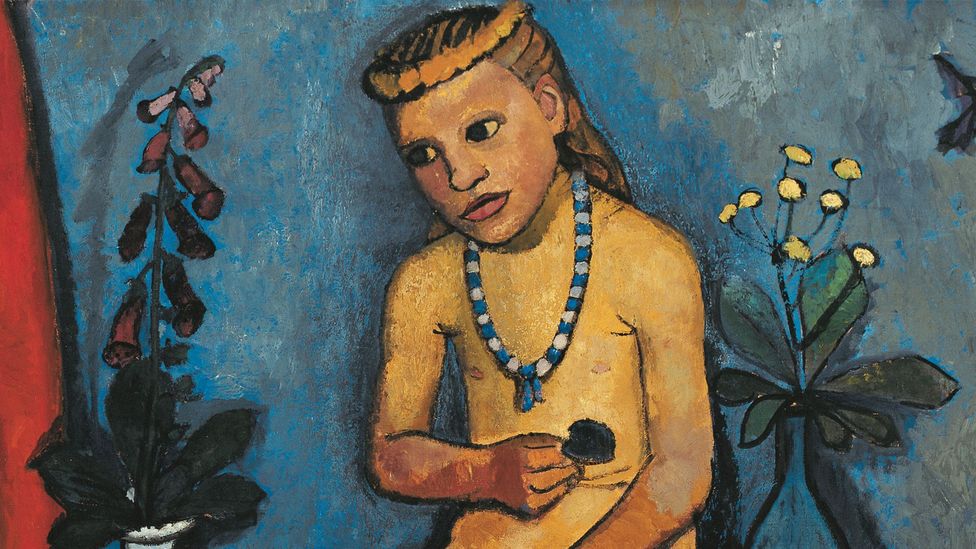
Paula Modersohn-Becker, recently the subject area of a major retrospective at the Schirn Kunsthalle in Frankfurt, too famously made herself the subject field of her portraits, along with other women, children and the local peasantry. Influenced past the Fayum mummy portraits which she discovered in Paris around 1905, her portraits accept a psychological intensity rare in depictions of women at the time. Although her pick of models was at least partly down to convenience, she still treats the humblest of subjects with the utmost nobility. "They were the poorest in society and she gave them an air of timelessness, almost holiness," says curator Ingrid Pfeiffer.
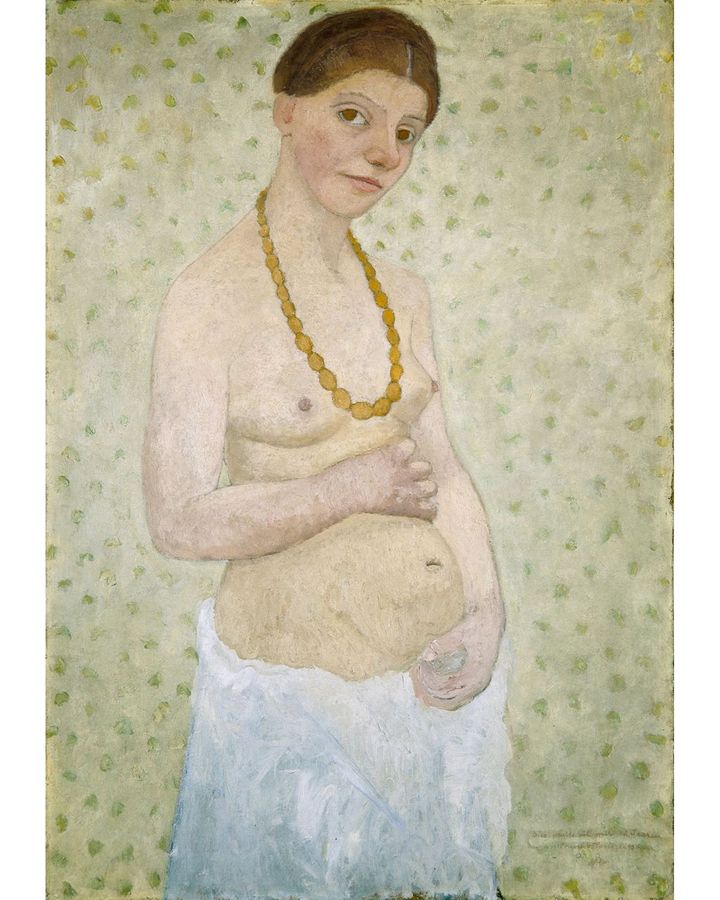
Self-Portrait on the Sixth Wedding Twenty-four hour period past Paula Modersohn-Becker. The artist was not agape to challenge convention (Credit: Paula Modersohn-Becker Museum, Bremen)
Modersohn-Becker's almost pantheistic love of nature is evident throughout her work including in her most famous painting Self Portrait on the Sixth Wedding Anniversary painted in 1906 where she appears nude from the waist upward. Although she appears to exist significant, she was non. "Her belly is a symbol of fertility, both human and artistic," says Pfeifer. Modersohn-Becker was acutely aware of her talent but at the same fourth dimension knew her subject matter meant the work could never exist exhibited. "Nobody saw it during her lifetime, not even (her husband) Otto. She knew she was painting something completely taboo," says Pfeiffer.
Similar Modersohn-Becker, 20th-Century artist Alice Neel was unafraid to challenge convention. Rejecting the abstract expressionism that dominated the artworld at the fourth dimension, she saw portraiture as a way in which to create a visual history of her era. Instinctively drawn to those on the margins of order she was able to critique the circumstances they establish themselves in while still portraying them with dignity. "For her it'due south a way of changing society," says Lucía Agirre, who curated the recent exhibition of Neel's portraits at the Guggenheim in Bilbao.
"She had a special empathy with her sitters. Usually she chose people she really liked, kids in the street or activists or her friends who were communist writers. For her these people accept something to say," explains Agirre. Neel had a particular affinity for the emotional and physical struggles of women, especially deprived women such equally herself, and did not shy abroad from subjects that were taboo, including the domestic abuse of her neighbour Peggy. "In 1949 she made this beautiful portrait of Peggy, and you see the marks on her face but at the same fourth dimension she gives her dignity. At that fourth dimension it was something you just didn't talk about," says Agirre.
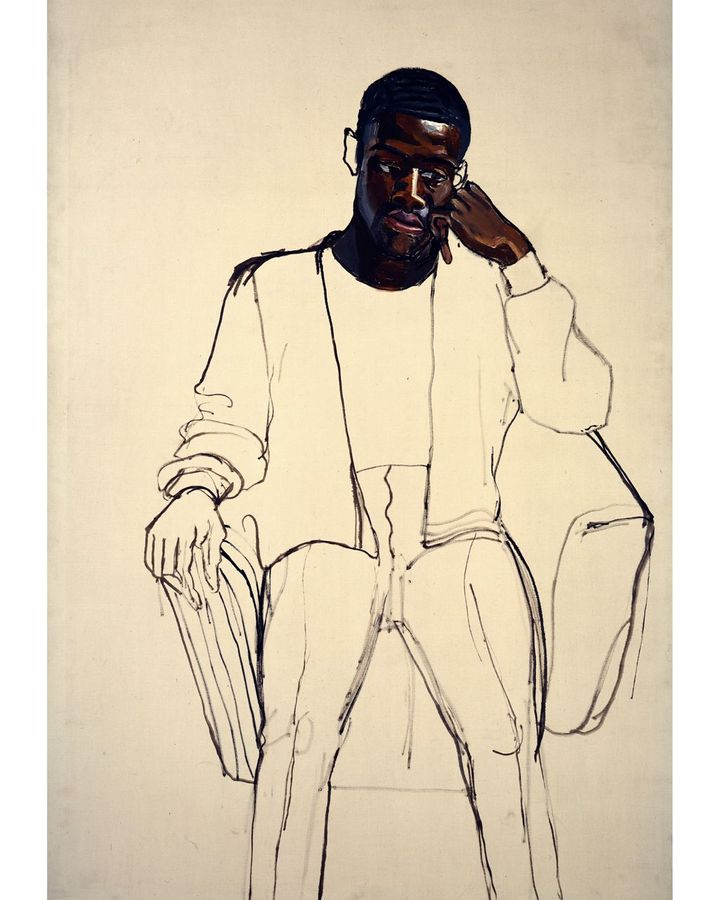
Black Draftee (James Hunter) by Alice Neel. In her portraits Neel celebrates and commemorates the subjects (Credit: The Estate of Alice Neel, Bilbao, 2021)
Although Neel did non proceeds recognition for her ground-breaking portraits until relatively late in her career, their documentary and democratic nature reveals the standing relevance of portraiture, likewise every bit the multiple functions that portraits tin can serve. They commemorate, celebrate, and evidence u.s. who we were – and who we are now.
Past collecting practices combined with the fact that many notable figures never had the opportunity to exist painted or photographed means that portrait galleries tin never hope to be wholly representative of a nation's by, but the closer we get to the nowadays, the more than inclusive the representation becomes. "Our criteria for admissions is much broader now. It goes beyond political, religious and legal figures. Information technology'south more democratic and today we celebrate different forms of achievement," says Smith. And certain historical biases can be addressed.
The lack of representation of women is something the National Portrait Gallery is seeking to tackle while it is airtight for refurbishment. Inquiry is being done into women already in the drove and new acquisitions will be made. With such a vast range of portraits to draw on – at that place are 12,000 in the master collection simply the reference collection is around 400,000 – being asked to select highlights is a near impossible job. Only when asked to do so, Smith'south choices emphasise the unique nature of portraiture and the reasons for its enduring hold on the public'south imagination. Hans Holbein'southward drawing of Henry Seven and Henry VIII, a preparatory study for a painting now lost, and The Ditchley Portrait of Elizabeth I, transport united states of america into the orbit of some of the most celebrated monarchs in British history. They are likewise magnificent works of art in their own right.
The portrait of William Shakespeare and that of the Brontë sisters by their brother Branwell, which Smith also chooses, are not. Notwithstanding, they are some of the about popular with the public, simply because they offer a means of connection with such well-loved literary figures. Laura Knight's Self Portrait with Model is chosen as it is "a really fundamental piece of work for the history of women in the arts " while of the more contemporary commissions Smith selects Malala'south portrait past Shirin Neshat which has been a huge draw for visitors.
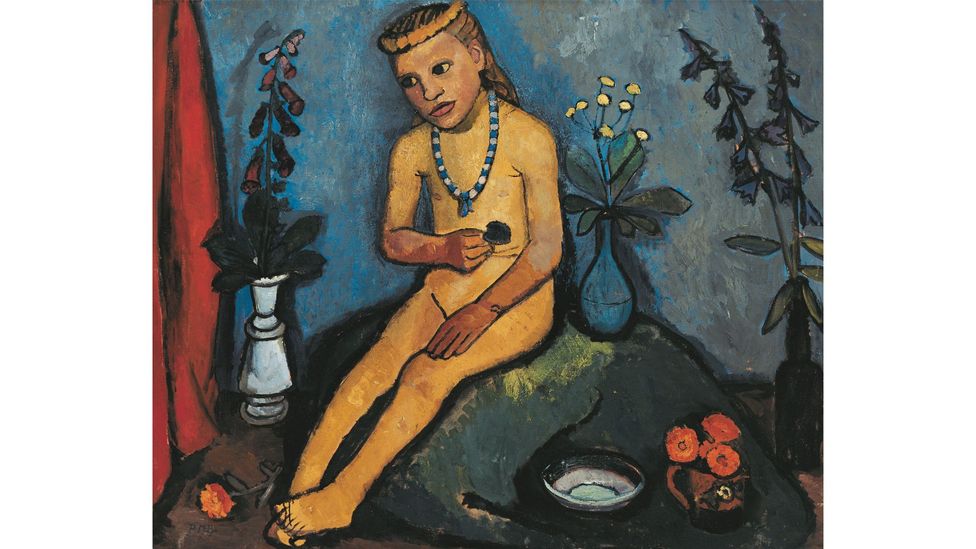
Nude Girl with Flower Vases by Paula Modersohn-Becker is typical of the artist's intense, timeless portraiture (Credit: Von der Heydt-Museum Wuppertal)
And of course, beyond the neat and the skillful, the humblest among us have the take a chance to be celebrated every year in the BP Portrait Award, although that is currently on concord while the gallery is closed. "Information technology's hugely pop considering the people in that show are ordinary people. It could be your sis, your brother or some model you discovered on the street and establish interesting," says Smith.
"It's that fellowship of human beings. Whereas in the by it was actually a mark of rank or status or celebrity, I think at present portraiture is more about existentialism. Information technology's about psychology, who they are and how they fit into society. Information technology's about identity," says Smith. Whether Emperor, thespian, activist or everyday person on the street, that is something we all share – and explains why portraiture will never stop to control our attending.
If y'all would like to comment on this story or anything else y'all have seen on BBC Culture, head over to our Facebook page or message united states on Twitter .
And if you liked this story,sign up for the weekly bbc.com features newsletter, called The Essential Listing. A handpicked pick of stories from BBC Time to come, Culture, Worklife and Travel, delivered to your inbox every Friday.
Source: https://www.bbc.com/culture/article/20220204-why-portraits-have-fascinated-us-for-millennia
0 Response to "Why Is There Strong Fascination With Nonwestern Art Culture in the United States"
Post a Comment